For hospitals on MEDHOST Enterprise and EDIS
MEDHOST antibiogram software for community hospitals that build the yearly antibiogram from MEDHOST Enterprise lab results
MEDHOST keeps your culture and susceptibility results in the chart, and some hospitals license Sentri7 through MEDHOST for stewardship surveillance. The cumulative antibiogram on the formulary committee table is usually still a spreadsheet one pharmacist rebuilds every winter.
Try the builder on the sample data, or drop in your own CSV. It is parsed in your browser and never uploaded.
Short answer
MEDHOST antibiogram software takes a delimited export of finalized susceptibility results from MEDHOST Enterprise, the lab system beside it or your reference lab, and builds the cumulative antibiogram from that one file. Antimicrobe counts the first isolate per patient per period, flags any organism under 30 isolates as CLSI M39 recommends, pools years when one year is too thin, and prints house-wide, urine and emergency department tables with a rule receipt. The Lab plan is $249 a month for one hospital, bought by card, with no MEDHOST interface project.
What a MEDHOST hospital already has
MEDHOST, based in Franklin, Tennessee, has sold to community hospitals for more than 40 years and markets its EHR as a hosted and managed solution with a predictable technology cost. Its clinical suite covers physician, nursing, perioperative, anesthesia and pharmacy work, and MEDHOST EDIS is its emergency department system. MEDHOST Enterprise carries ONC 2015 Edition certification as a complete inpatient EHR.
Two MEDHOST announcements matter for the antibiogram. On June 8, 2023 MEDHOST said it would offer its customers the full Wolters Kluwer Sentri7 surveillance suite, which it described as Sentri7 Pharmacy with Antimicrobial Stewardship, AUR Reporting, Infection Prevention and Sepsis Monitor. On October 14, 2025 it announced an expanded Reference Lab Discrete Results Interface that brings discrete results, microbiology included, into the EHR instead of as scanned or text reports.
That second change is good news for antibiogram work. A small hospital that sends blood cultures or susceptibility testing out to a reference lab can now hold those results as discrete rows, which is exactly what a cumulative antibiogram needs.
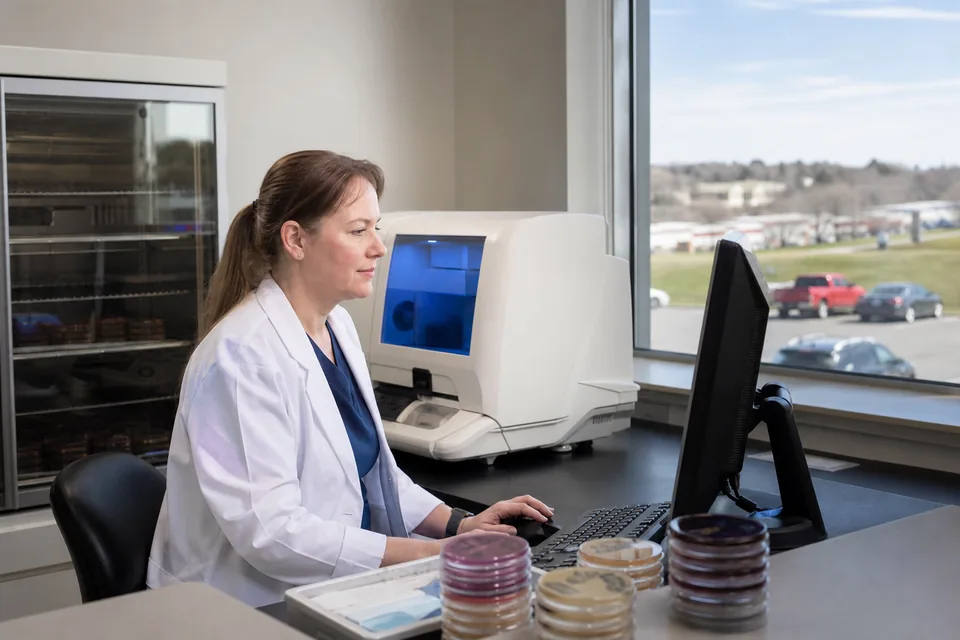
Where a MEDHOST antibiogram usually comes from today
MEDHOST does not publicly describe a CLSI M39 cumulative antibiogram report in Enterprise, and its customer documentation sits behind the MEDHOST Community login. In practice a MEDHOST hospital gets its antibiogram in one of three ways.
If Sentri7 already sits on your MEDHOST contract, ask whether its antibiogram covers what your committee wants before buying anything else. If you are weighing Sentri7 mainly for the antibiogram, compare the routes on Sentri7 alternatives first.
- From Sentri7, if the hospital licenses the suite. Wolters Kluwer says Sentri7 produces an antibiogram, alongside real-time stewardship alerts and NHSN reporting
- From the lab instrument data manager, such as a VITEK 2 or Phoenix data system, which sees only the isolates that instrument tested
- From a line list exported out of MEDHOST or the LIS and finished by hand in Excel, which is the most common route at a hospital under 100 beds
What goes wrong in the hand-built version
The spreadsheet route works until someone checks it. These are the problems that show up when a MEDHOST line list becomes an antibiogram in Excel, and each one moves real percentages at a community hospital where the denominators are small.
How small hospitals handle thin counts, pooled years and regional data is compared on critical access hospital antibiogram software.
- Repeat cultures counted as new isolates. Three positive urines from one patient in a month are one isolate under M39, and in a column of 50 E. coli the extra two shift the number by several points
- Reference lab results missing or duplicated. Results that arrived as text before the discrete interface, or that came back both ways, are easy to drop or count twice
- Preliminary results in the file. A report that pulls every result instead of finalized ones keeps susceptibilities the lab later corrected
- Thin organisms printed as percentages. Most community hospitals reach 30 isolates a year for E. coli and Staph aureus and for very little else
- Emergency, inpatient, swing bed and clinic cultures mixed in one table, because nobody split them by location on purpose
How to export antibiogram data from MEDHOST
Ask whoever writes lab reports, usually the lab manager, the MEDHOST system administrator or the analyst who supports pharmacy, for one delimited file of finalized microbiology susceptibility results for the analysis period. If microbiology is verified in a separate LIS, take the file from the LIS, because that is where the result is final. If most cultures go to a reference lab, ask for the lab's own line list too.
One row per organism and drug works, and so does one row per isolate with a column per drug. Include a patient identifier (a hashed one is fine), collection date, location or patient type, specimen source, organism, antimicrobial and the released interpretation. Keep the location column so the EDIS emergency department cultures can be split out, which matters because many community hospitals treat and discharge most of their urinary tract infections from the ED.
A column-by-column example of a clean export is on laboratory information system exports, and reference lab files are covered in antibiogram software for reference labs.
-
1
MEDHOST or LIS report
Finalized susceptibility results for the year, with location and specimen source
-
2
CSV file
One delimited export, plus the reference lab line list if cultures were sent out
-
3
Antimicrobe
First isolate per patient, 30 isolate flag, years pooled when one year is too thin
-
4
Antibiogram
House-wide, urine and ED tables with counts and a rule receipt for the committee
MEDHOST with Sentri7, Excel and Antimicrobe compared
The free desktop route is WHONET, which reads the same delimited export. The practical trade-offs are on the WHONET alternative page.
| Question | MEDHOST plus Sentri7 | MEDHOST line list and Excel | Antimicrobe |
|---|---|---|---|
| What you buy | A full surveillance suite | Nothing, staff hours | The antibiogram only |
| Antibiogram | Yes, inside Sentri7 | Built by hand each year | Built from the CSV, CLSI M39 rules |
| NHSN AUR files | Yes, Sentri7 is on the CDC lists | No | No |
| Real-time patient alerts | Yes | No | No |
| First isolate and 30 isolate rules | Vendor configured | Only if the sheet does it | On by default, counts shown |
| Price published | No, quoted | Not applicable | $249 a month on the Lab plan |
Does a MEDHOST hospital need Sentri7 for NHSN AUR?
MEDHOST itself did not appear on the CDC NHSN vendor lists for the Antimicrobial Use or the Antimicrobial Resistance Option when we checked them in October 2026 (the lists were last reviewed on June 24, 2026 and May 12, 2026). Wolters Kluwer's Sentri7 does appear. That fits MEDHOST's own 2023 announcement, which offered Sentri7 to customers so they could submit AUR data to NHSN under the CMS Promoting Interoperability requirement. Confirm your own route with MEDHOST, because the lists change and can lag a new validation by two months.
The AUR files and the antibiogram start from the same finalized susceptibility results, but they serve different readers. AUR goes to NHSN. The antibiogram goes to your prescribers, your stewardship committee and the order sets. Antimicrobe does the second job only, so it works whether your AUR route is Sentri7, another certified vendor or something else.
Which AUR products CDC has validated, and what each costs, is compared in NHSN AUR reporting software compared.
Which plan fits a MEDHOST hospital
A single MEDHOST hospital producing a house-wide, urine and emergency department antibiogram needs the Lab plan, $249 a month for one facility, 25,000 isolates a year and two seats, bought by card with no implementation fee. Two seats usually means the pharmacist who owns stewardship and the lab manager or infection preventionist.
A hospital that also wants unit cuts, syndrome groups, quarterly trends and MDRO counts, or that reports an attached rural health clinic or nursing home as its own facility, uses Stewardship at $749 a month for up to three facilities. A multi-hospital MEDHOST system that wants one pooled regional report plus each hospital's own uses Network at $2,400 a month for twelve facilities. Annual billing is half the monthly price.
Every limit is on the pricing page. Community hospitals on other small hospital EHRs will find their route on CPSI EHR antibiogram software and Paragon EHR antibiogram software.

What this does not do
- It does not connect to MEDHOST directly or through HL7. It reads exported files, as often as you export them
- It does not reinterpret MICs or zone sizes. It uses the S, I and R your lab released
- It does not replace MEDHOST, your LIS or your reference lab interface for result entry, verification or reporting
- It does not submit antimicrobial use or resistance data to NHSN
- It does not send real-time alerts on individual patients, which is what Sentri7 is for
Related reading: critical access hospital antibiogram software, CPSI EHR antibiogram software, Paragon EHR antibiogram software, Sentri7 alternatives, CLSI M39 antibiogram software, tele antimicrobial stewardship software. The four steps from susceptibility testing data to an antibiogram cover the method end to end.
Questions
On this page's topic
Does MEDHOST have an antibiogram report?
MEDHOST does not publicly describe a CLSI M39 cumulative antibiogram report in MEDHOST Enterprise, and its user guides sit behind a customer login, so ask your MEDHOST contact what your site has. Hospitals that license Sentri7 through MEDHOST get Sentri7's antibiogram. Others export a line list and build the report in Excel or in a tool such as Antimicrobe.
How do I export microbiology results from MEDHOST?
Ask your lab manager or MEDHOST administrator for a delimited report of finalized susceptibility results for the year, with patient identifier, collection date, location, specimen source, organism, drug and released interpretation. If microbiology is verified in a separate LIS or at a reference lab, export from there instead. Save it as CSV and upload it.
Do we need Sentri7 to get an antibiogram on MEDHOST?
No. Sentri7 is a full surveillance suite with real-time alerts, AUR reporting and infection prevention, and its antibiogram comes with that. If the antibiogram is the only gap, a CSV-based antibiogram tool covers it at a published price, and you can still add Sentri7 later for alerts and NHSN reporting.
Is MEDHOST validated for NHSN AUR reporting?
MEDHOST did not appear on the CDC NHSN AU or AR vendor lists when we checked them in October 2026, while Sentri7 did. MEDHOST announced Sentri7 in June 2023 as its customers' route to AUR submission. The lists can lag a new validation by up to two months, so confirm your status with MEDHOST.
What if most of our cultures go to a reference lab?
Use both files. Export what MEDHOST holds, including results that now arrive through its Reference Lab Discrete Results Interface, and add the reference lab's own line list for the same period. Antimicrobe removes duplicates by patient, organism and date, so a culture that appears in both files is counted once.
How much does antibiogram software for a MEDHOST hospital cost?
Antimicrobe's Lab plan is $249 a month for one hospital, bought by card with no implementation fee, and it reads MEDHOST, LIS and reference lab exports. Stewardship is $749 a month for unit cuts, trends and MDRO counts across up to three facilities, and Network is $2,400 a month for multi-hospital systems.
More on antimicrobial resistance reporting
- hospital antibiogram The annual antibiogram is the most reused document a microbiology laboratory produces, and u...
- antimicrobial resistance surveillance software Resistance surveillance in a US hospital usually means one person, one annual spreadsheet an...
- CLSI M39 antibiogram software Most antibiograms that fail an M39 review fail on the same four things: repeat isolates coun...
- BD EpiCenter antibiogram EpiCenter already holds every Phoenix result your lab produced this year. The work starts af...
- VITEK 2 antibiogram Your VITEK 2 already produced every MIC and interpretation the antibiogram needs. The hard p...
- MicroScan antibiogram Your WalkAway already produced every MIC and interpretation the antibiogram needs. The year-...
Start with your own export
See your own resistance picture, cut the way you actually work
Build the antibiogram on the synthetic sample dataset, or drop in your own CSV and watch it parse without leaving your browser. When you want an account, one email address is the whole sign-up.
Your file is parsed in your browser and never uploaded. No card required.