For CPSI and TruBridge EHR hospitals
CPSI EHR antibiogram software that turns a TruBridge EHR lab export into a CLSI M39 antibiogram for a small hospital
Your TruBridge EHR lab already stores every culture and sensitivity result your hospital released. Turning those results into an antibiogram a 25-bed hospital can trust, with honest counts and pooled years, is the part that still lands on one pharmacist with a spreadsheet.
Try the builder on the sample data, or drop in your own CSV. It is parsed in your browser and never uploaded.
Short answer
CPSI EHR antibiogram software takes a delimited export of finalized culture and sensitivity results from the TruBridge EHR laboratory system (formerly CPSI Thrive) and builds the cumulative antibiogram from it. Antimicrobe keeps the first isolate per patient per period, flags organisms under 30 isolates as CLSI M39 recommends, pools two or three years when one year is too thin, and prints the rules applied with counts. The Lab plan is $249 a month for one facility, bought by card.
What the TruBridge EHR lab already holds
Most CPSI hospitals are small. TruBridge, the company that was called Computer Programs and Systems, Inc. until March 2024, says in its 2025 annual report that about 98% of its acute care EHR hospital customers have fewer than 100 beds. Those are the community and critical access hospitals where one pharmacist runs stewardship and the lab has two or three technologists covering every bench.
The laboratory system inside TruBridge EHR is a full hospital LIS. In the CAP TODAY 2025 laboratory information system survey, TruBridge lists its EHR Laboratory Information System, formerly Thrive EHR LIS from CPSI, at 494 US sites, with 15 new sales between August 2024 and July 2025. It reports microbiology culture and sensitivity as available, says it interfaces instruments directly rather than through third-party middleware, and describes 99% of its US installs as low volume.
That last point is the whole antibiogram problem in one number. The data is in one place and it is clean enough. There just is not much of it, and the tools built for 500-bed hospitals print percentages on denominators a small hospital never reaches.
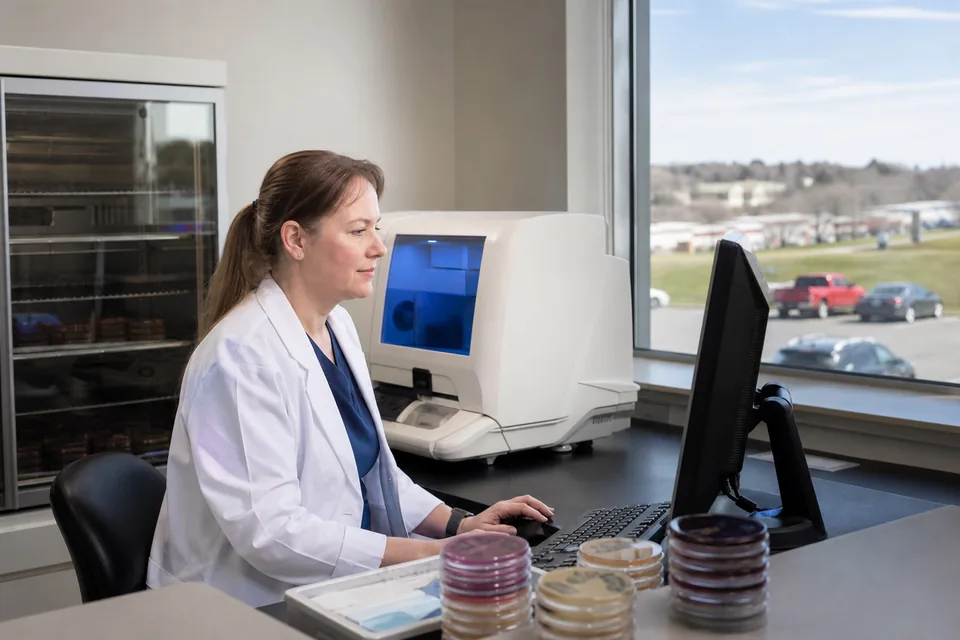
Where a CPSI antibiogram usually falls short
TruBridge does not publicly describe a ready-made CLSI M39 cumulative antibiogram report. Its public pages and its CAP TODAY survey entry cover the LIS and its microbiology module, and the user guides sit behind a customer login. In practice most CPSI hospitals build the yearly antibiogram from a report or a line list and finish it by hand, which is where these problems come in.
Small hospital options for pooling, regional data and counts are compared on critical access hospital antibiogram software.
- Thin denominators. A 25-bed hospital may reach 30 isolates for E. coli in a year and for little else, so most cells either need pooled years or should be shown as counts
- Duplicate cultures. A patient with four positive urines is one isolate under M39, and in a denominator of 40 the extra three move the percentage by several points
- Send-out results. Cultures read at a reference lab come back into the chart, but sometimes as a scanned report instead of discrete results, and those never reach a query
- Mixed settings. Swing bed, rural health clinic and attached nursing home cultures sit in the same system and get pooled with inpatients or dropped without anyone deciding which
- One person, once a year. The pharmacist who builds it in January has not touched the spreadsheet since last January and rebuilds the formulas from memory
How to export antibiogram data from TruBridge EHR
Ask whoever runs reports for the lab, often the lab manager or the hospital's TruBridge system administrator, for one delimited file of finalized microbiology susceptibility results for the analysis period. One row per organism and drug, or one row per isolate with a column per drug, both work. The columns that matter are a patient identifier (hashed or pseudonymous is fine), collection date, location or patient type, specimen source, organism, antimicrobial and the released interpretation.
Keep a patient type or location column so inpatient, emergency, clinic, swing bed and nursing home cultures can be cut apart or pooled on purpose. If some cultures are sent out, check that the reference lab results came back as discrete results and not only as a scanned report. If they did not, most reference labs will send a CSV line list for your facility on request, and that file can be added beside the TruBridge export.
WHONET users should know that BacLink has no ready-made template for TruBridge or CPSI. The WHONET guide to laboratory information system exports gives detailed templates only for MEDITECH Magic and Cerner Classic and asks every other LIS for a delimited text export. That is the same file Antimicrobe reads.
What a good laboratory export looks like, column by column, is on laboratory information system exports.
-
1
TruBridge EHR report
Finalized culture and sensitivity results for the year, with patient type and specimen source
-
2
CSV file
One delimited export, plus a reference lab line list if some cultures were sent out
-
3
Antimicrobe
First isolate per patient, 30 isolate flag, years pooled when one year is too thin
-
4
Antibiogram
House-wide and urine tables with counts, the pooling window and a rule receipt
TruBridge reports, WHONET and Antimicrobe compared
WHONET is the free route and suits a lab with time to learn it on a Windows machine. The practical differences are on the WHONET alternative page.
| Question | TruBridge report and Excel | WHONET with BacLink | Regional or state antibiogram | Antimicrobe |
|---|---|---|---|---|
| Whose patients | Yours | Yours | Other hospitals in the region | Yours, plus a reference lab file if needed |
| First isolate per patient | Only if built into the sheet | Yes, if configured | Set by the state | On by default, counts shown |
| Under 30 isolates | Manual | Configurable | Usually suppressed | Flagged, years pooled on request |
| Swing bed and clinic cultures | Mixed in unless filtered | Filterable after setup | Not applicable | Cut apart or pooled by choice |
| Who can open it | A PDF or a spreadsheet | Whoever has WHONET | Anyone, it is public | Seats for pharmacy and infection prevention |
| Cost | Staff hours | Free, paid in staff hours | Free | $249 a month on the Lab plan |
Does a CPSI antibiogram follow CLSI M39?
It follows M39 only as far as the report and the spreadsheet do. TruBridge stores the results. Whether the first isolate per patient per period is kept, whether results that were not final are left out, whether species under 30 isolates are suppressed and whether pooled years are labeled is decided by whoever builds the report.
For a small hospital the 30 isolate rule matters more than anything else on the page. CLSI M39 recommends not printing a percent susceptible on fewer than 30 isolates. The honest alternatives are pooling two or three years with the window printed, showing the raw count, or pointing prescribers to a regional report. Antimicrobe does all three and prints a rule receipt with isolate counts before and after de-duplication, so the committee and a surveyor can see how each number was made.
Each M39 rule and how common tools handle it is on CLSI M39 antibiogram software.
What the IKS Health acquisition means for TruBridge hospitals
TruBridge is no longer a public company. Inventurus Knowledge Solutions, the US arm of India-based IKS Health, agreed to buy it on April 23, 2026 for $26.25 a share in cash and completed the acquisition on July 9, 2026, when TruBridge stock stopped trading on Nasdaq. TruBridge said at signing that the combined company would support more than 2,000 healthcare organizations.
Nothing in the deal documents says what changes for the EHR or the lab system, and it would be guesswork to predict. What a hospital can control is how much of its antibiogram depends on any one vendor's report builder. A report built from a plain CSV keeps working through upgrades, a new owner's roadmap or a later EHR change, because the rules live in the report tool and not in the LIS.
Which plan fits a CPSI hospital
A single TruBridge hospital producing a house-wide and urine antibiogram needs the Lab plan, $249 a month for one facility, 25,000 isolates a year and two seats, bought by card with no implementation fee and no interface. Two seats usually means the pharmacist who owns stewardship and the infection preventionist or lab manager.
A hospital that also wants unit cuts, syndrome groups, quarterly trends and MDRO counts, or that reports for an attached clinic and nursing home as separate facilities, uses Stewardship at $749 a month for up to three facilities. A rural network or a group of TruBridge hospitals pooling a regional report uses Network at $2,400 a month.
Every limit is on the pricing page. How small hospitals compare stewardship tools more broadly is covered in antibiotic stewardship software for critical access hospitals.

What this does not do
- It does not connect to TruBridge EHR directly or through HL7. It reads exported files, as often as you choose to export them
- It does not reinterpret MICs or zone sizes. It uses the S, I and R your lab or reference lab released
- It does not replace the TruBridge lab system for result entry, verification or reporting to clinicians
- It does not submit antimicrobial use or resistance data to NHSN
- It does not send real-time alerts on individual patients
Related reading: Paragon EHR antibiogram software, critical access hospital antibiogram software, CLSI M39 antibiogram software, laboratory information system exports, nursing home antibiogram software, WHONET alternative. The four steps from susceptibility testing data to an antibiogram cover the method end to end.
Questions
On this page's topic
Does CPSI have an antibiogram report?
TruBridge EHR, formerly CPSI, stores the culture and sensitivity results an antibiogram needs, and its lab system includes a microbiology module. TruBridge does not publicly describe a ready-made CLSI M39 cumulative antibiogram report, and its user guides sit behind a customer login, so ask your TruBridge contact what your site has. Most small hospitals finish the report by hand.
How do I export microbiology results from TruBridge EHR?
Ask your lab manager or TruBridge system administrator for a delimited report of finalized susceptibility results for the year, with patient identifier, collection date, location or patient type, specimen source, organism, drug and released interpretation. Save it as CSV. That one file is enough for Antimicrobe, and it is also what WHONET's BacLink would need.
Is CPSI the same as TruBridge?
Yes. Computer Programs and Systems, Inc., known as CPSI, renamed itself TruBridge, Inc. on March 4, 2024 and merged its Evident and TruBridge subsidiaries into the parent. The hospital EHR once sold as Evident Thrive is now TruBridge EHR, and its lab system is listed as TruBridge EHR Laboratory Information System.
Who owns TruBridge now?
Inventurus Knowledge Solutions, the US subsidiary of IKS Health, completed its acquisition of TruBridge on July 9, 2026, paying $26.25 a share in cash. TruBridge stock was delisted from Nasdaq the same day. The deal was announced on April 23, 2026.
What if our cultures go to a reference lab?
Check whether the results come back into TruBridge EHR as discrete results or only as a scanned report. Discrete results can be exported with everything else. If they arrive as a document, ask the reference lab for a CSV line list for your facility and upload it beside the TruBridge export. Antimicrobe de-duplicates across both files.
How much does antibiogram software for a CPSI hospital cost?
Antimicrobe's Lab plan is $249 a month for one facility, bought by card with no implementation fee, and it reads TruBridge and reference lab exports. Stewardship is $749 a month for unit cuts, trends and MDRO counts across up to three facilities, and Network is $2,400 a month for rural networks.
More on antimicrobial resistance reporting
- hospital antibiogram The annual antibiogram is the most reused document a microbiology laboratory produces, and u...
- antimicrobial resistance surveillance software Resistance surveillance in a US hospital usually means one person, one annual spreadsheet an...
- CLSI M39 antibiogram software Most antibiograms that fail an M39 review fail on the same four things: repeat isolates coun...
- BD EpiCenter antibiogram EpiCenter already holds every Phoenix result your lab produced this year. The work starts af...
- VITEK 2 antibiogram Your VITEK 2 already produced every MIC and interpretation the antibiogram needs. The hard p...
- MicroScan antibiogram Your WalkAway already produced every MIC and interpretation the antibiogram needs. The year-...
Start with your own export
See your own resistance picture, cut the way you actually work
Build the antibiogram on the synthetic sample dataset, or drop in your own CSV and watch it parse without leaving your browser. When you want an account, one email address is the whole sign-up.
Your file is parsed in your browser and never uploaded. No card required.