Orchard Harvest LIS antibiogram software for small hospital labs, from the Orchard LIS export to a CLSI M39 report
Orchard Harvest stores every culture and susceptibility result a small hospital lab releases. The cumulative antibiogram is still a spreadsheet one person rebuilds each January, and the Clinisys acquisition is a good moment to stop doing that.
8 min read
A hospital lab on Orchard Harvest LIS builds its cumulative antibiogram from a Harvest query or report of finalized susceptibility results. The realistic routes are that query finished in Excel, WHONET fed by a delimited export, or an antibiogram tool such as Antimicrobe that reads the same export and applies the CLSI M39 rules for you, starting at $249 a month. Harvest keeps the data well. The M39 decisions are made by whoever builds the report.
This is written for the lab director, microbiology lead or pharmacist at a small or critical access hospital running Harvest who owns the yearly antibiogram and has no analyst for it. Orchard and Clinisys are described only from their own public pages, newsletters and announcements.
What an Orchard Harvest lab already has
Orchard Software of Carmel, Indiana has sold Harvest LIS for over two decades. It was first called Costello and took the Harvest name with version 3.2, according to Orchard's own 2008 newsletter. Its customers have long been the labs that larger LIS vendors underserve, and an Orchard 2009 newsletter profiled Wabash Community Hospital, a 25-bed critical access hospital in Indiana, as a Harvest site.
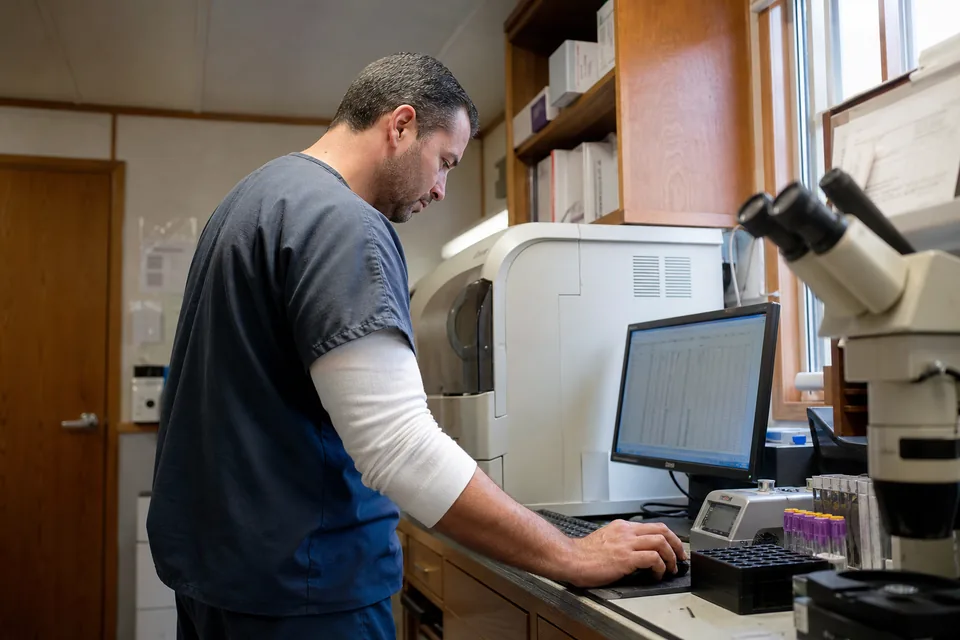
For microbiology, Clinisys describes Harvest as offering electronic microbiology worksheets, HL7 reporting of results to health departments, surveillance systems and the CDC, and on-demand data mining with customizable queries and standardized reports. Instrument results post to the worksheet; an Orchard newsletter described MicroScan identifications flowing in automatically as early as 2003. So the finalized organism and susceptibility data an antibiogram needs is already stored as data.
What Orchard and Clinisys do not publicly describe is a CLSI M39 cumulative antibiogram report in Harvest. That is the gap a January spreadsheet fills.
Three ways to build the antibiogram on Harvest
The Harvest query plus Excel is where nearly every Orchard lab starts, and it is where the M39 work goes missing. Repeat cultures from the same patient are counted as new isolates, preliminary results slip into the file, and a percentage gets printed on 11 Klebsiella isolates because the cell had room for one. WHONET applies the rules properly, but it is a Windows program someone has to relearn each year, and its guide to laboratory information system exports gives detailed templates only for MEDITECH Magic and Cerner Classic, so a Harvest lab feeds it a delimited file anyway.
Antimicrobe reads that same delimited file in a browser. It keeps the first isolate per patient per period, uses final results only, flags organisms under 30 isolates and pools years on request, then prints a rule receipt with counts before and after de-duplication.
The full list of M39 rules and how each tool handles them is on CLSI M39 antibiogram software.
| Route | Who does the work | CLSI M39 rules | Cost |
|---|---|---|---|
| Harvest query plus Excel | Lab director or pharmacist | Only what the sheet applies | Staff hours |
| WHONET with BacLink | Whoever learns WHONET | Yes, if configured | Free, paid in staff hours |
| Antimicrobe | Anyone who can upload a CSV | First isolate, final only, 30 isolate flag, by default | From $249 a month |
How to get the export from Orchard Harvest
Ask whoever writes Harvest queries, usually the lab director or the LIS coordinator, for one delimited file of finalized microbiology susceptibility results for the analysis period. Include a patient identifier (hashed is fine), collection date, location or patient type, specimen source, organism, antimicrobial and the interpretation. Keep the location column, so emergency, inpatient, swing bed and clinic cultures can be split or pooled on purpose.
Small hospitals send a share of cultures to a reference lab, and those results often come back as PDF reports instead of discrete rows. If they never enter Harvest as data, they never reach the antibiogram either. Either ask the reference lab for a line list, or use document data extraction to turn the PDF reports into rows before you merge them with the Harvest file.
A column-by-column example of a good export is on laboratory information system exports, and merging reference lab results is covered in antibiogram software for reference labs.
Can a small hospital on Harvest publish a valid antibiogram?
Yes, with fewer organisms and more pooling. CLSI M39 asks labs not to print a percent susceptible on fewer than 30 isolates. A 25 to 100 bed hospital usually clears that for E. coli and Staphylococcus aureus each year and for little else, so the honest report shows those rates, pools two or three years for Klebsiella, Proteus and Pseudomonas with the years labeled, and gives counts instead of percentages for the rest.
Separating settings matters as much as the counts. A Harvest lab often serves the hospital, the emergency department, an attached clinic and sometimes a nursing home. Mixing them in one table hides the urine rates that outpatient prescribers actually need.
How critical access hospitals handle thin counts and regional data is laid out on critical access hospital antibiogram software.
What the Clinisys acquisition means for Harvest labs
Clinisys announced on July 29, 2025 that it had acquired Orchard Software from Francisco Partners, which had bought Orchard in 2019. Clinisys said Orchard products are used by more than 2,000 laboratories across the United States, including physician groups, hospitals, reference labs, student health centers, veterinary clinics and public health organizations. Clinisys already owned Sunquest, so two of the best-known US hospital lab systems now sit with one vendor.
We found no public end-of-life announcement for Harvest, and Clinisys still lists it as a product. Still, an ownership change is when labs review contracts, versions and reports. An antibiogram built from a plain CSV export does not depend on which LIS produced it, so it keeps its rules and year-over-year trend through a Harvest upgrade, a SaaS move or a later change of LIS.
Hospitals on the other Clinisys system can see the Sunquest route on Sunquest LIS antibiogram software.
How much does antibiogram software cost for a Harvest lab?
Most Harvest hospitals pay in staff hours: a lab director and a pharmacist spending a few days each January on the query and the spreadsheet. Enterprise surveillance platforms that include an antibiogram do not publish prices and are bought for alerts and NHSN reporting, which a small hospital may not need from a separate vendor.
Antimicrobe publishes its plans. Lab is $249 a month for one facility, 25,000 isolates a year and two seats, bought by card with no implementation fee, which fits a single Harvest hospital. Stewardship is $749 a month for up to three facilities, useful when the clinic or nursing home is reported separately. Network is $2,400 a month for a rural network that wants one regional report plus each hospital's own.
Every limit is on the pricing page, and the wider cost picture is in antibiogram software cost.
Questions to ask before you choose
- Who can write the Harvest query for final susceptibility results, and can they save it for next year?
- Does our current antibiogram keep only the first isolate per patient per period, and can we see the counts?
- Which organisms have fewer than 30 isolates, and are we printing percentages on them?
- Are reference lab results in the data, or only on PDF reports in a folder?
- Are hospital, emergency, clinic and nursing home cultures separated?
- Will the report survive a Harvest upgrade or a change of LIS without being rebuilt?
Related on this site: critical access hospital antibiogram software, Sunquest LIS antibiogram software, CPSI EHR antibiogram software, CLSI M39 antibiogram software, Antimicrobe pricing.